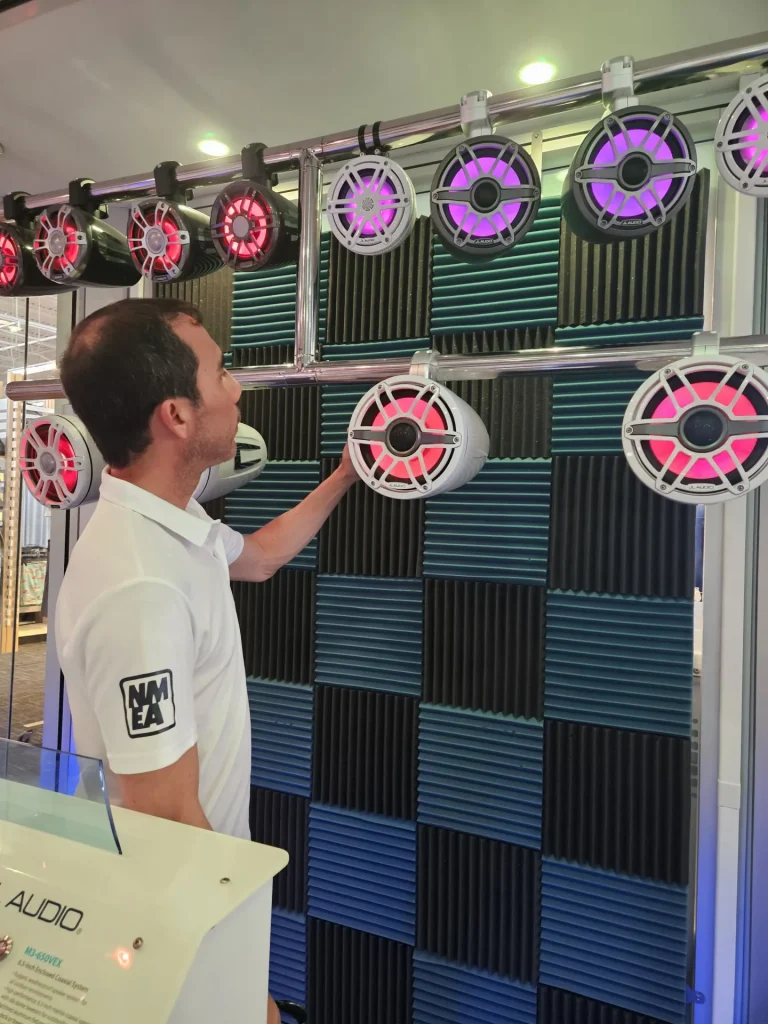
Head units, speakers, amplifiers and audio zones built to survive...
Read MoreUnderwater lights transform a boat at night: the water glows, the hull stands out at the dock and, for anglers, the light draws bait and fish. Modern LED underwater lights are bright, efficient and available in single colors or full color-changing systems.

This guide explains the types of underwater lights, how to choose colors and brightness, where to place them and how a durable installation is done.
Mounted on the outside of the transom with only a small hole for the cable. They are the simplest to retrofit, often without hauling the boat.
Installed through the hull for the brightest output and a clean look. They usually require a haul-out and careful sealing.
Compact lights that replace the drain plug on smaller boats.
Blue is the classic look at the dock and in clear water. Green penetrates water well and attracts plankton, which brings baitfish, so many anglers prefer it. White shows the most detail. RGB color-changing systems let you choose and often control colors from a panel or an app.
Brightness is measured in lumens, but beam angle matters too: a narrow beam projects farther, a wide beam lights more water near the hull. LED has fully replaced halogen for underwater use thanks to its efficiency and lifespan.
Bezels are made of marine-grade materials such as bronze, polycarbonate and stainless steel, and LEDs draw fewer amps than traditional incandescent lights.
Lumitec is among the underwater lighting brands we install most often, and its range includes several models. They differ in output, mounting style, color options and control systems, so the right choice depends on the hull, the look you want and how the lights will be controlled.
Before recommending a model, we check the transom or hull construction, the space inside and the available power.
Single-color lights usually run from a simple switch. Color systems add a controller that can be operated from a wall panel, a remote, a phone app or, on many yachts, the chartplotter or digital switching system. Several lights can be synchronized so the whole hull changes color at once, and scenes can be saved for the dock, for fishing or for entertaining guests.
Lights are usually installed on the transom, symmetrically on both sides of the engines or drives, and deep enough to stay submerged when the boat is at rest. Larger yachts often add lights along the hull sides.
The number of lights depends on the boat length, the beam and the effect you want. Placement must also avoid trim tabs, transducers, intakes and anodes, and keep the lights clear of turbulence and propeller wash.
Any light below the waterline must be installed with care. A durable installation includes:
OnBoat Marine installs surface-mount and thru-hull underwater lights on boats and yachts on site across Broward, Miami-Dade and Palm Beach counties, coordinating haul-outs when thru-hull lights are needed.
See our specialized lighting systems service, read our boat lighting guide, or contact us for a quote.
Surface-mounted lights can often be installed in the water. Thru-hull lights usually require a haul-out.
Green is the most popular for fishing because it penetrates water well and attracts plankton, which brings bait and fish.
Not when installed correctly. Proper sealing, bedding and backing keep the hull watertight and strong.
Many models rely on water for cooling and should only be run briefly out of the water. Follow the manufacturer guidance for your lights.
It depends on the boat size and the effect you want. Two lights suit many smaller boats; larger yachts often use four or more.
Need help? Request a quote or see our Specialized Lighting Systems services.
Head units, speakers, amplifiers and audio zones built to survive...
Read MoreLED navigation, deck, courtesy and interior lighting, planned and installed...
Read MoreAC/DC distribution, breakers, digital switching and when to upgrade your...
Read More