Marine Solar Panels for Boats and Yachts

Marine solar panels recharge your batteries silently every day the sun is out, which in South Florida is most of the year. They keep batteries topped up on boats stored at moorings or on lifts, reduce generator hours at anchor and extend the time you can stay away from the dock.

This guide covers how to size a solar system, the panel and controller options, where to mount the panels and what makes an installation last in the marine environment.

Why Solar Works on Boats

  • Silent, free charging with no fuel and no moving parts.
  • Healthier batteries: banks that are recharged daily last longer than banks left partly discharged.
  • Less generator time at anchor, and a backup source if another charging system fails.
  • Low maintenance: keep the panels clean and check the connections.

Solar will not run air conditioning on its own, but on most boats it can cover refrigeration, electronics and lighting, or a large part of them.

Boats on lifts and moorings

Boats that sit for weeks between trips, on a lift, a mooring or a dock without power, slowly lose charge to bilge pumps, alarms and standby electronics. A small solar panel with its own controller keeps the batteries full, keeps the bilge pump working and means the boat starts the next time you arrive. It is one of the most cost-effective upgrades for boats that are not always plugged in.

Sizing a Solar System

Start from your daily energy use in amp-hours, the same figure used to size a battery bank. As a rough guide, a well-placed 100-watt panel can produce around 25 to 35 amp-hours per day on a 12-volt system in good South Florida sun, less on cloudy days or with partial shade.

Compare that with the space available on the hardtop, bimini, arch or deck. On many boats the space, not the budget, sets the size of the system, so high-efficiency panels and careful layout make a real difference. The battery bank should be able to store what the panels produce; see our marine batteries guide.

Rigid vs. Flexible Panels

Rigid panels

Glass and aluminum frame panels offer the best efficiency and lifespan. They are the first choice for hardtops, arches and dedicated frames.

Semi-flexible panels

Lightweight and low profile, they can follow the curve of a bimini or a deck. They are ideal where rigid panels do not fit, though they usually run hotter and have a shorter life.

Whatever the panel, it must be rated for the marine environment, with corrosion-resistant hardware and connectors.

Charge Controllers and Monitoring

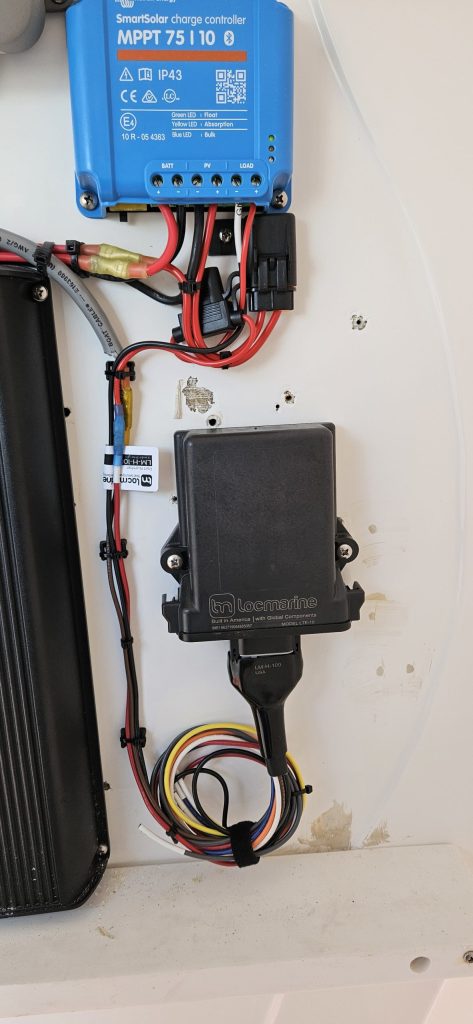
The charge controller sits between the panels and the batteries and charges them with the correct profile. MPPT controllers extract noticeably more energy than basic PWM controllers, especially in heat and when panel voltage is higher than battery voltage, so they are our standard recommendation.

The controller must be configured for the battery chemistry, including lithium where applicable. With a battery monitor or a connected display, you can see solar production and battery state of charge at a glance.

Mounting, Shading and Wiring

Even partial shade from an antenna, radar or outrigger can cut a panel output dramatically, so layout matters as much as panel size. Panels in shade-prone positions may be wired on separate controllers.

A durable installation uses secure, through-bolted or bonded mounts, sealed cable glands where wires pass through the deck, marine-grade tinned wire sized for the run, and a fuse or breaker between controller and battery.

Solar Installation Across South Florida

OnBoat Marine designs and installs marine solar systems on site across Broward, Miami-Dade and Palm Beach counties, from a single panel on a center console to multi-panel arrays on yacht hardtops, integrated with the battery bank, chargers and monitoring.

See our battery banks and charging systems service or contact us for a solar evaluation of your boat.

Frequently Asked Questions

How much solar do I need on my boat?

It depends on your daily energy use and the space available. As a rough guide, each well-placed 100-watt panel can produce about 25 to 35 amp-hours per day on a 12-volt system in good sun.

Not on their own on most boats. Solar is best for refrigeration, electronics and lighting, and for keeping batteries charged.

MPPT controllers harvest more energy than PWM controllers, especially in hot weather. For most marine systems they are worth the difference.

They are useful where rigid panels do not fit, such as biminis, but they usually run hotter and last less than rigid panels.

Yes, with a charge controller configured for lithium and integrated with the battery management system.

Call Now

Contact