VHF Radio, AIS & Marine Communication

The VHF radio is the most important safety device on board. It reaches the Coast Guard, nearby boats, bridges and marinas, and with DSC it can send your position in a distress call at the press of a button. Paired with AIS, it also shows you who is around you and lets them see you.

This guide covers fixed VHF radios, AIS receivers and transponders, antennas and cabling, and the other communication systems found on yachts.

Fixed VHF Radios and DSC

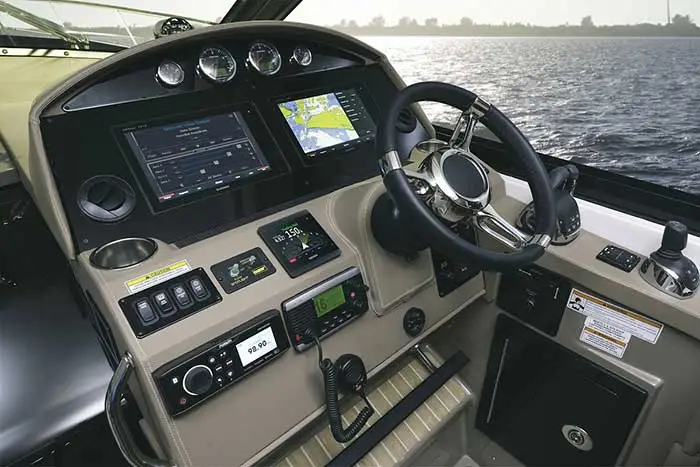
A fixed-mount VHF transmits at up to 25 watts, compared with 5 or 6 watts for a handheld, and uses a mast or arch antenna, so its range is far greater. Every current fixed VHF includes DSC (Digital Selective Calling): with an MMSI number programmed and a GPS position connected, the red distress button sends your identity and location to the Coast Guard and nearby vessels.

Look for a clear display, a second station or wireless handset for the flybridge or cockpit, a loudhailer output if you need one, and NMEA 2000 connectivity to share position and AIS data with your chartplotter.

Understanding AIS

The Automatic Identification System broadcasts each vessel identity, position, course and speed. On a chartplotter, AIS targets appear with their name and closest point of approach, which makes busy inlets and night passages far easier to manage.

  • AIS receive-only, often built into a VHF such as the Garmin VHF 215 AIS, shows other vessels but does not broadcast your position.
  • AIS transponders both receive and transmit, so ships and other boats can see you. Recreational boats use Class B units; commercial vessels use Class A.

AIS Transponders

Among the transponders we install are the Garmin AIS 800, Raymarine AIS700, Vesper Cortex M1, Digital Yacht AIT5000 and Em-trak B200 series. Newer Class B units using SOTDMA transmit at higher power and more often than older CSTDMA units, which helps you stay visible in congested waters.

A transponder needs its own GPS antenna, a VHF antenna (shared through a splitter or dedicated) and a connection to the chartplotter network. Some units, like the Vesper Cortex, combine VHF, AIS and remote monitoring in one system.

VHF Antennas

VHF is line-of-sight, so antenna height matters more than transmitter power. A higher antenna reaches farther and hears more.

  • Fiberglass antennas come in different lengths and gains. Higher-gain antennas (around 6 to 9 dB) concentrate the signal toward the horizon and suit larger, stable boats; lower-gain antennas (around 3 dB) keep a wider pattern for smaller boats and sailboats that roll and heel.
  • Stainless whips are durable and common on sailboat mastheads.
  • Compact antennas fit hardtops and tight spaces at some cost in range.

Cabling and Installation

A good radio with a poor antenna installation performs like a cheap one. A reliable installation uses low-loss coaxial cable sized for the run, properly soldered and sealed connectors, separation between the VHF, AIS and other antennas, and a splitter when one antenna is shared between VHF and AIS.

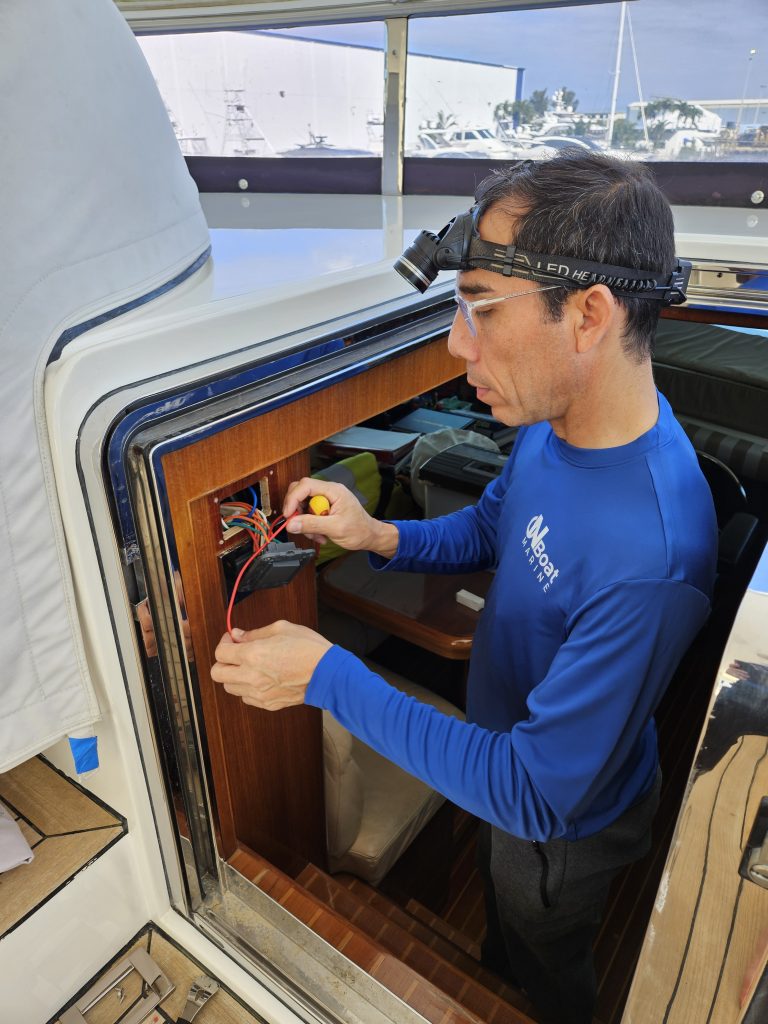
We also program the MMSI, connect GPS and NMEA 2000, and test transmission and reception before handing the boat back. For offshore passages beyond VHF range, SSB/HF radio and satellite systems add long-range communication; for onboard internet, see our yacht connectivity service.

Communication Systems Across South Florida

OnBoat Marine installs VHF radios, AIS, antennas, intercoms and loudhailers on site across Broward, Miami-Dade and Palm Beach counties.

See our marine communication service, our marine radar guide for the collision-avoidance side, or contact us to plan your upgrade.

Frequently Asked Questions

How far can a marine VHF radio reach?

VHF is line of sight, so range depends mostly on antenna height on both ends. Boat-to-boat range is typically limited to a few miles to a couple of dozen miles; coast stations with tall antennas reach farther.

Yes, to use DSC. Without an MMSI, the distress button cannot identify your vessel. We can program the MMSI during installation.

A receiver shows you other vessels. A transponder also makes your boat visible to ships and other AIS users, which is especially valuable offshore and in busy channels.

Yes, with a proper AIS/VHF splitter. A dedicated antenna for each is also an option when there is space.

The most common causes are a low or damaged antenna, corroded connectors or degraded coaxial cable. An antenna and cable test usually finds the problem.

Need help? Request a quote or see our Communication services.

Call Now

Contact